Basic Poker Rules in Texas Hold’em: How One Hand Unfolds
Poker can look complicated from the outside because so many terms and actions happen quickly. In reality, the basic poker rules, especially for Texas Hold’em, the variant most often taught first, can be understood in a single sitting. The key is to see the game as a sequence of steps that repeats in the same pattern every hand.
This guide walks you through one hand from the first card dealt until the pot changes hands. Betting order, table position, and the showdown are covered in more depth in other articles, so the focus here is the big picture that makes all those details make sense.
The Goal of the Game in Basic Poker Rules
Every hand of poker has one prize: the pot, which is the collection of chips that all players put in during that hand. There are two ways to win the pot. First, you hold the best five-card combination when the cards are revealed at the end. Second, every other player gives up before the end, leaving you as the only player remaining.
Understanding both paths early is important. Poker is not only about who holds the strongest cards. It is also about the decisions each player makes throughout the hand. That is why poker is often described as a game of incomplete information: you know your own cards, but you do not know your opponents’ cards.
Equipment and Number of Players
Texas Hold’em uses a single standard deck of 52 cards with no jokers. A table usually seats two to ten players. A round marker called the dealer button shows who is technically acting as the dealer for that hand. The button moves one seat clockwise after each hand ends.
- A 52-card deck with four suits (spades, hearts, diamonds, clubs) and thirteen ranks from 2 to Ace.
- Chips to keep track of bets, so every player knows exactly how much is at stake.
- The dealer button to set the order of action and decide who pays the blinds.
Blinds: The Forced Bets That Start a Hand
Before any cards are dealt, the two players to the left of the dealer button must post opening bets called blinds. The first player posts the small blind, and the second posts the big blind, which is usually twice the small blind. The purpose is simple: there is always something in the pot, so every hand has something to compete for.
Because the button moves every hand, the duty to pay the blinds also rotates. Over one full orbit of the table, every player pays the small blind and the big blind once, which keeps the arrangement fair.
Hole Cards and Community Cards
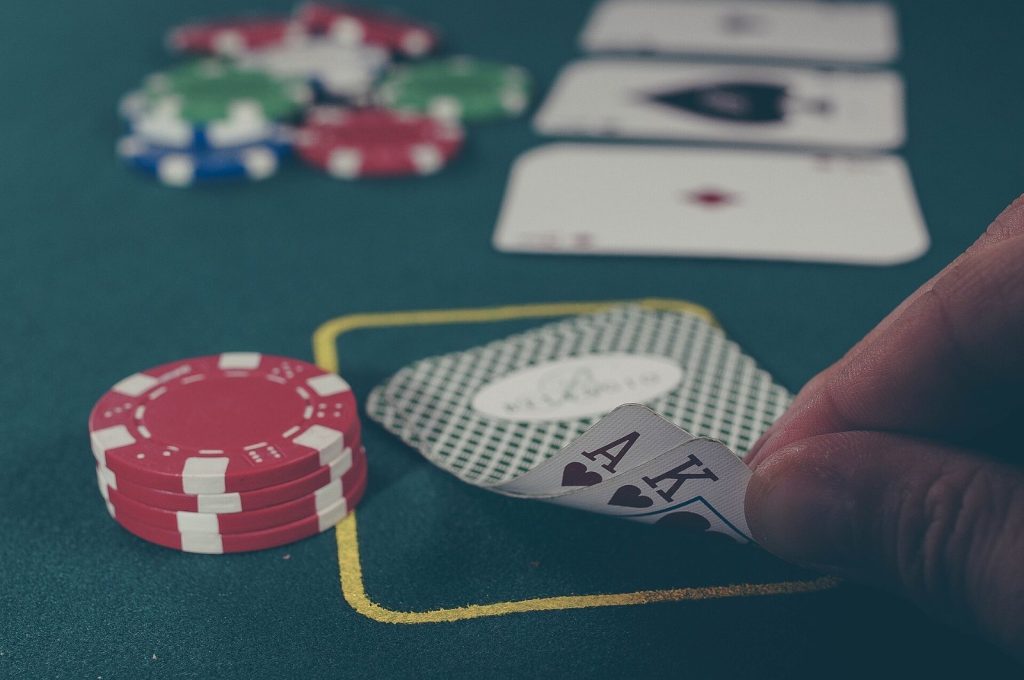
Each player receives two face-down cards called hole cards. Only the owner may look at them. The dealer then reveals five community cards in the middle of the table in stages. Every player can use these shared cards.
At the end of the hand, you build the best five-card combination from the seven cards available to you: your two hole cards and the five community cards. You may use both hole cards, only one, or even none if the five cards on the board already form your best hand.
Four Betting Rounds in a Single Hand
One hand of Texas Hold’em is divided into four betting stages. In each stage, the players still in the hand act one at a time in clockwise order.
- Preflop: after the two hole cards are dealt, before any community cards appear.
- Flop: the dealer reveals three community cards at once, followed by a betting round.
- Turn: the fourth community card is revealed, followed by another betting round.
- River: the fifth community card is revealed, followed by the final betting round.
On each turn, the basic options are check (pass without adding chips when no bet has been made), bet (put chips in), call (match the current bet), raise (increase the current bet), or fold (give up and leave the hand). Before community cards are revealed, the dealer usually discards the top card face down. This is called the burn card, and it helps prevent anyone from guessing the next card.
How the Pot Is Finally Won
If at any stage only one player remains because everyone else folded, that player wins the pot immediately without showing any cards. If two or more players are still in after the river betting round, the hand goes to a showdown. The cards are revealed, and the best five-card combination according to the poker hand rankings wins the pot. If two hands are exactly equal, the pot is split evenly.
After the pot is paid, the cards are gathered and shuffled, the dealer button moves one seat, and a new hand begins with new blinds.
Learning Calmly and Responsibly
The most comfortable way to learn this flow is to play with chips that have no money value among friends, reviewing each stage as you go. Keep in mind that laws on card games played for money differ from country to country, and some countries ban gambling entirely. Poker is best treated as entertainment for adults, not as a source of income.
Once the flow of a single hand feels familiar, the next step is to study betting order and table position in more detail. Those two topics give every decision at the poker table its context.